
Something feel off?Check it before you click.
Paste a suspicious message, check a link, or tell us about a call. Get clear warning signs and practical next steps.
Let’s take a closer look.
- 01Add what you received.
- 02See the warning signs.
- 03Choose your next step.
Recent scam alerts
All alertsRead a link from the right, not the left
The start of a link is the easiest part to fake. In hxxps://usps.parcel-help.example[.]com/track, the familiar name is a subdomain that anyone can create.
Stickers with fake QR codes are turning up on parking meters
The FTC says people have reported QR code stickers placed over the real ones on parking meters. Scanning the sticker opens a look-alike payment page that collects card numbers or logins.
Cloned car dealership websites are taking deposits for cars that do not exist
According to the FTC, scammers copy a real dealer site, logos, listings, photos and all, then collect upfront payments. Buyers find out when the real dealership has no record of them.
Give your family a heads-up.
Eight printable pages: the warning signs, marked-up examples, a family plan to fill in, and a checklist for the fridge. No email needed.
Get the free family guideWant the workbook, scripts, and contact cards too? See the Family Safety Kit, $19.
Know what to watch for.
Each guide has a marked-up example, the warning signs, and what to do about it.
The missed delivery text
How fake USPS, UPS, and FedEx delivery texts work, the warning signs in the link, and how to check your real tracking status.
The fake bank call
What bank impersonation calls and texts sound like, why "move your money to a safe account" is always a scam, and how to reach your real bank.
The family emergency
How family impersonation texts and calls work, what to do in the moment, and a family verification plan that takes five minutes to set up.
Put a plan on paper.
Everything above is free. The kits are for sitting down together, at home or across an organization, and writing the plan down.
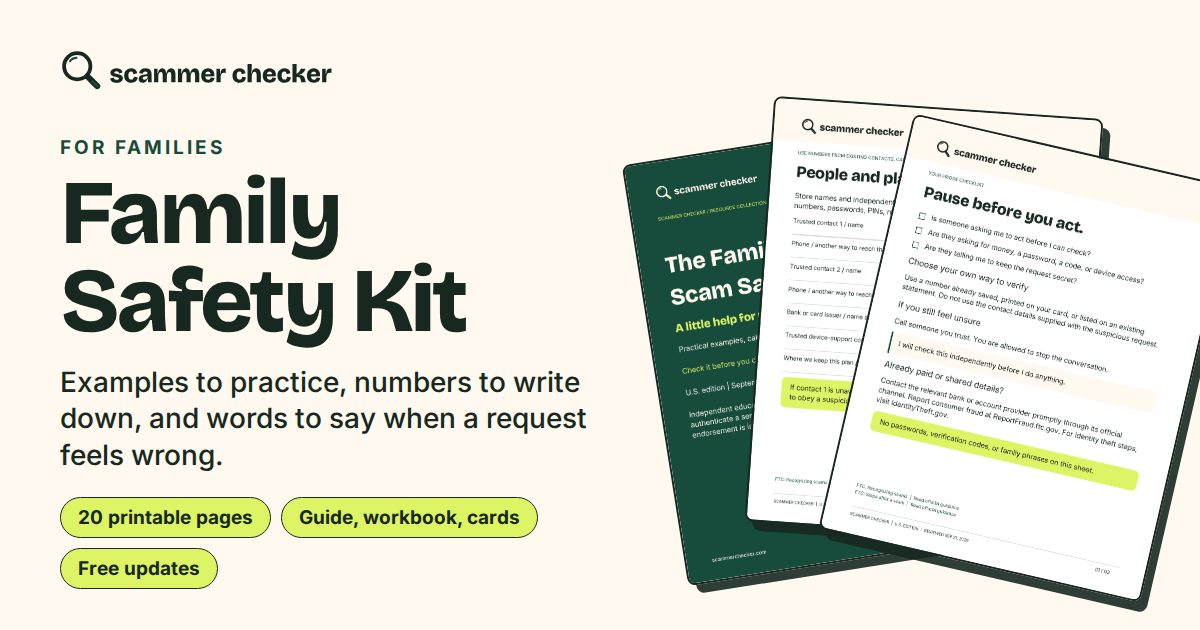
Family Safety Kit
Twenty printable pages: six practice examples, a fill-in family plan, scripts for asking for help, a fridge checklist, and contact cards.
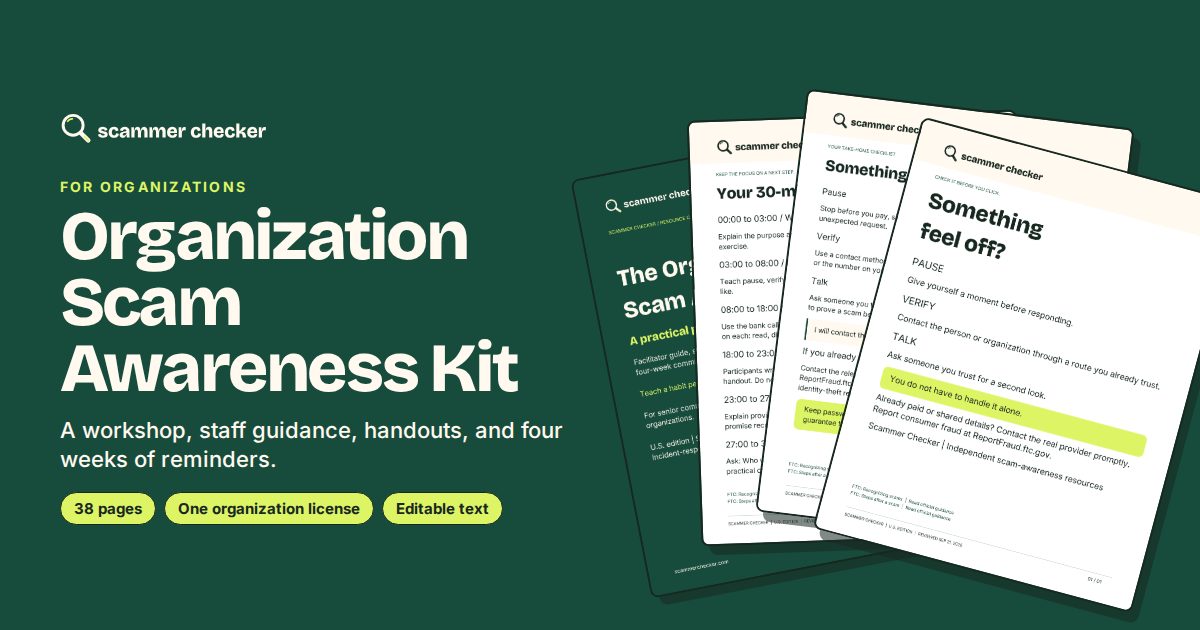
Organization Scam Awareness Kit
A ready-to-run program for senior communities, home-care agencies, and advisers: a 30 minute workshop, staff guidance, handouts, a poster, and four weeks of emails.
Go deeper.
Scam statistics: what the latest FTC and FBI numbers actually say
Americans reported losing $15.9 billion to fraud in 2025. Here are the official figures, what they mean, where they come from, and how to quote them correctly.
How to get your money back after a scam, by payment method
What you can recover depends on how you paid and how fast you act. A step-by-step guide for cards, bank transfers, Zelle, Venmo, Cash App, wires, gift cards, crypto, cash, and checks.
How to talk to your parents about scams without starting an argument
A practical script for adult children: what to say, what not to say, the five things to set up together in 30 minutes, and what to do if a parent has already lost money.
What this can and can’t do
Does Scammer Checker tell me if something is safe?
No. It looks for common warning signs and tells you what it found. If nothing matches, the result reads "Unable to establish trust", because no match is not evidence that a message is legitimate. Only the real organization can confirm that, through contact details you found yourself.
Where does the text I paste go?
Nowhere. The checker runs inside your browser. What you paste is not sent to a server, not saved on your device, and not included in any analytics. Close the tab or press "Clear my check" and it is gone.
Do you open or scan the links I paste?
No. We read the link as text and show you its parts, including the registrable domain that decides where it leads. We do not visit it, follow redirects, or scan for malware, so a short link stays unverified.
Is this an AI?
No. Results come from a published set of written rules, each with a plain explanation and a source. The same input always gives the same result. You can read how it works on the How it works page.
Can I look up a person, a phone number, or a business?
No. Despite the name, this is not a lookup of people. It does not verify anyone's identity, run background checks, or search phone numbers. It looks at the message, link, or call you describe and points out common scam warning signs, so you can decide how to check through a source you trust.
Is a report here an official fraud report?
No. Reports sent to us help us describe new patterns for other readers. To report fraud in the U.S., use ReportFraud.ftc.gov, and IC3.gov for internet crime.
Who runs this?
Scammer Checker is an independent educational project from Sideroad. It is not a government service, an antivirus product, or an identity monitoring service, and it cannot guarantee your safety.